
Generative and Agentic AI in Intelligent Enterprise Systems
This page focuses on agentic AI as an architectural element of intelligent enterprise systems.
The primary perspective is not generative AI as a standalone technology, but AI-augmented systems that support architectural reasoning, system understanding, and continuous optimization in complex enterprise landscapes. Agentic AI is understood as a set of AI-based software agents that assist human experts by analyzing systems in context, understanding business logic, and supporting informed architectural and modernization decisions.
This architectural view builds on the evolution from classical enterprise systems to real-time, in-memory platforms and extends these principles towards AI-augmented enterprise architectures.
The concepts presented here connect long-standing research in enterprise systems and real-time architectures with academic teaching and applied system development. They reflect how architectural principles can be translated into practice and continuously governed over the lifecycle of large SAP-based enterprise systems.
This line of thinking directly informs current applied work on AI-augmented platforms for SAP system analysis, transformation, and long-term governance.
Intelligent Enterprise Systems
Architectural Advances in Real-Time SAP Systems – From In-Memory Computing to AI-Augmented Enterprise Architectures
Over the past decades, enterprise systems have undergone several fundamental architectural shifts. Traditional database-centric architectures, designed primarily for transactional consistency and delayed reporting, reached their limits as enterprises increasingly required real-time insight, system-wide optimization, and immediate operational response.
Early research and industrial work on real-time databases, in-memory data processing, and large-scale optimization — including supply-chain planning and execution — demonstrated that meaningful business decisions cannot be derived from delayed aggregates alone. Sustainable competitive advantage emerges when complete enterprise data sets can be processed, analyzed, and acted upon in memory, at low latency, across both transactional and analytical workloads.
This line of research laid the foundation for a new generation of enterprise systems.
The introduction of SAP HANA represented a decisive architectural break.
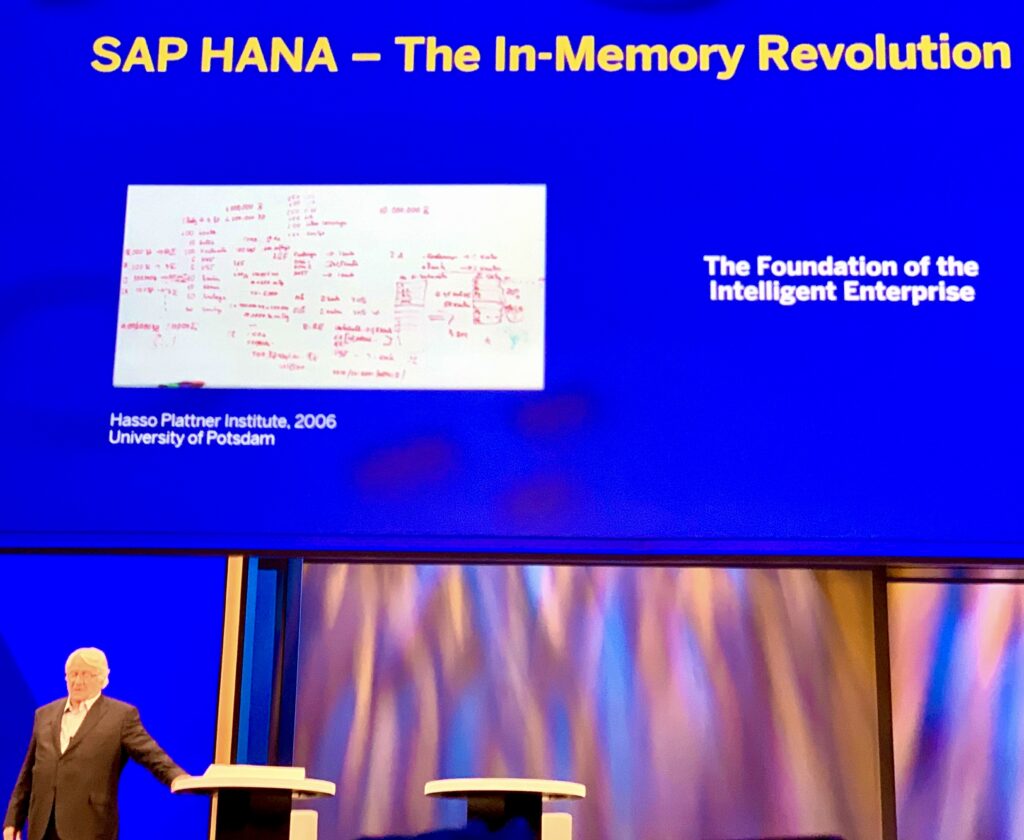
HANA Project, started in 2006 by Alexander and Hasso on the “New Architecture” for SAP Systems
By eliminating disk-bound constraints and unifying transactional and analytical processing on a single in-memory architecture, HANA enabled real-time visibility into operational data at unprecedented scale. For the first time, enterprises could evaluate end-to-end processes — such as Financial Accelerators (see picture below), supply chains, logistics, pricing, and production — directly on live data rather than relying on delayed snapshots.
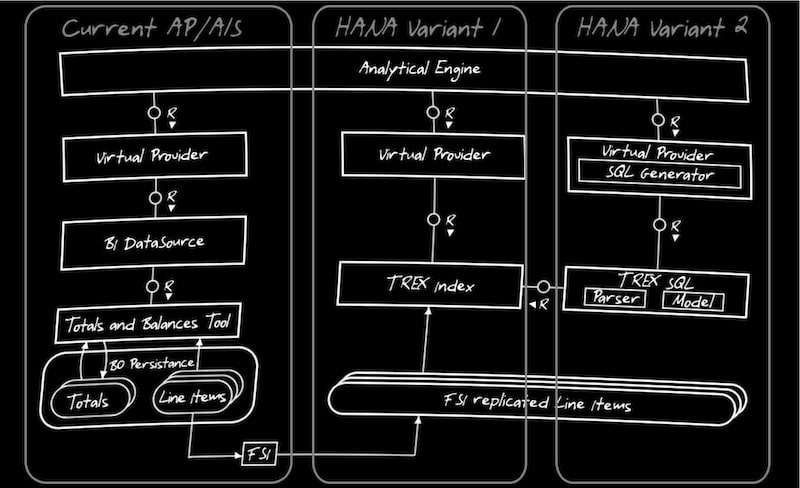
Financial Accelerator (FIA), as Part of the HANA Project
This architectural shift fundamentally changed how enterprise systems were designed and operated. Optimization could move from periodic planning cycles to continuous, system-wide decision-making based on the complete and current state of the enterprise.
SAP S/4HANA subsequently translated these architectural principles into a new generation of enterprise applications. While the data platform and core application layers were fundamentally re-architected, one structural challenge remained largely unresolved: decades of historically grown SAP custom code.
In many large enterprises, custom extensions accumulated across multiple system generations, often optimized for earlier architectures and tightly intertwined with business logic. While functionally essential, this custom code increasingly became a primary driver of complexity, upgrade risk, transformation cost, and long-term total cost of ownership.
SAP later introduced the concept commonly referred to as Clean Core to describe the architectural objective of stabilizing the core while enabling differentiation through extensions. Architecturally, however, achieving this objective requires more than guidelines. It demands deep system understanding, interfaces aligned with in-memory execution, and systematic approaches to analyzing, restructuring, and governing custom code over time.
Recent advances in AI-augmented, agentic systems now make it possible to address this challenge at architectural depth.
In this context, agentic does not imply autonomous enterprise systems. Instead, it refers to AI-based software agents that support human architects, developers, and decision-makers by continuously analyzing complex enterprise landscapes, understanding business logic in context, and assisting in architectural optimization and modernization decisions.
Agentic AI systems combine automated reasoning, contextual analysis, and human oversight. Rather than treating custom code transformation as a one-time project, such systems enable continuous architectural assessment and improvement across the full lifecycle of SAP landscapes — from initial transformation to long-term operation and governance.
In this sense, agentic AI represents a new architectural instrument. Similar to how in-memory computing transformed enterprise data processing, AI-augmented agentic systems enable enterprises to reason about, restructure, and sustainably improve complex enterprise architectures at scale.
This work builds on more than three decades of research, architectural invention, and large-scale execution.
Following early research in real-time databases, optimization, and supply-chain systems, the initiation of the SAP HANA project marked a critical inflection point. As co-inventor of HANA, the focus was explicitly the invention of a new architecture capable of processing complete enterprise data sets in real time.
The architectural origins of SAP HANA and its inventors are documented in an official joint press release by the Hasso Plattner Institute and Springer, which explicitly identifies Hasso Plattner and Alexander Zeier as inventors of the HANA in-memory architecture.
The original document is provided below for direct reference.
Skip to PDF contentAfter the introduction of HANA, the architectural challenge shifted from invention to execution at scale. During subsequent years as Managing Director and Global CTO for SAP at Accenture, these architectural principles were translated into enterprise reality across hundreds of global SAP and S/4HANA implementations. This work demonstrated that sustainable system quality, stability, and economic viability cannot be achieved through isolated projects alone, but require continuous architectural governance across the full lifecycle of enterprise systems.
Teaching and Academic Integration
These architectural concepts are integrated into teaching at the University of Magdeburg within the area of AI & Intelligent Enterprise Systems.
The topics of real-time enterprise architectures, in-memory computing, SAP HANA, S/4HANA, Clean Core principles, and AI-augmented agentic systems are incorporated into the lectures IMCLOUD 1 and IMCLOUD 2, which address modern enterprise and SAP system architectures.
Across the two consecutive semesters, students are introduced to architectural foundations of real-time enterprise systems, in-memory data processing and system design, challenges of enterprise transformation and custom code governance, and the role of AI-augmented agentic systems in supporting architectural analysis and decision-making.
At the end of the lecture sequence, the material is assessed in a formal examination covering both courses, awarding 6 ECTS credit points. The integration of agentic AI concepts reflects current architectural developments while maintaining a strong foundation in enterprise systems engineering.
Current Applied Work
In 2024, together with Emma Qian and Sam Yang, I co-founded Nova Intelligence to apply these architectural principles in practice.
Nova Intelligence develops an AI-augmented platform for SAP custom code lifecycle management. The platform analyzes SAP landscapes, understands business logic in context, and supports the systematic restructuring, optimization, and long-term governance of custom extensions in architectures optimized for high-performance, in-memory execution.
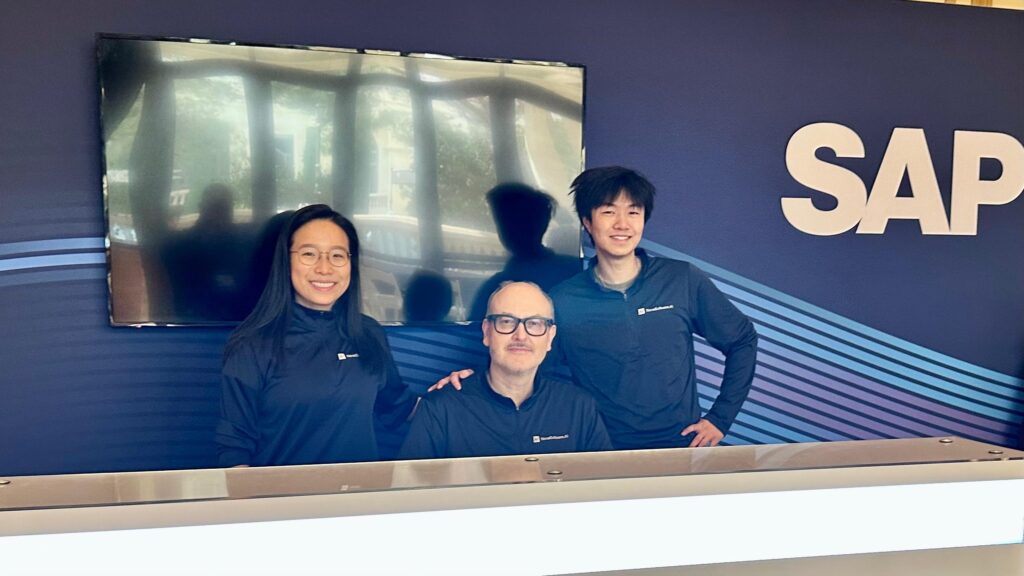
Emma Qian, Sam Yang, and Prof. Dr. Alexander Zeier co-founded Nova Intelligence in 2024
Rather than replacing human expertise, the platform augments it. Architects and developers are supported by AI agents that operate continuously across analysis, transformation, optimization, and governance — delivering immediate benefits while remaining applicable over long system lifecycles.
Further information on this applied work can be found at:
https://www.novaintelligence.com
From Architecture to Generative AI
While the work on Nova Intelligence focuses on the architectural application of agentic AI in real enterprise landscapes, generative AI plays a complementary role in this context.
Generative models are used to explore, explain, and illustrate complex technical and business domains, to externalize system knowledge, and to support learning, analysis, and discussion. Rather than acting as autonomous systems, they serve as interactive instruments that make architectural concepts, system behavior, and transformation challenges more accessible.
The following generative AI examples are therefore positioned as educational and exploratory extensions of the architectural principles discussed above.
Generative AI
In the context of academic exploration and the education of future technology leaders, we have developed three generative AI models that embody the intersection of research and practical application. These models serve as a foundation for students and scholars alike, offering insights into the optimization of business processes, the intricacies of SAP HANA and S/4HANA, and the legal challenges within the media landscape, thereby contributing to a comprehensive understanding of how AI can be harnessed to address real-world problems.
Generative AI models for business process improvement and optimization.
In the last few months, a few Custom GPTs were built for:
SAP HANA Advisor: SAP HANA consultant for technical and business audiences.
https://chatgpt.com/g/g-TzTv4RQ93-sap-hana-advisor-beta-test
SAP S4HANA and Cloud Transformation Advisor: GenAI Advisory Systems for Cloud, and SAP based on Composable Enterprise and Architecture with S4HANA and Cloud
https://chat.openai.com/g/g-6G1klDrm5-sap-s4hana-and-cloud-transformation-advisor
GPT Media Law Advisor: providing insights on media law, referencing Urteile Bundesverfasssungsgericht, pre-selected together with Prof. Holznagel
https://chat.openai.com/g/g-co2TPZNiS-gpt-media-law-advisor